 Source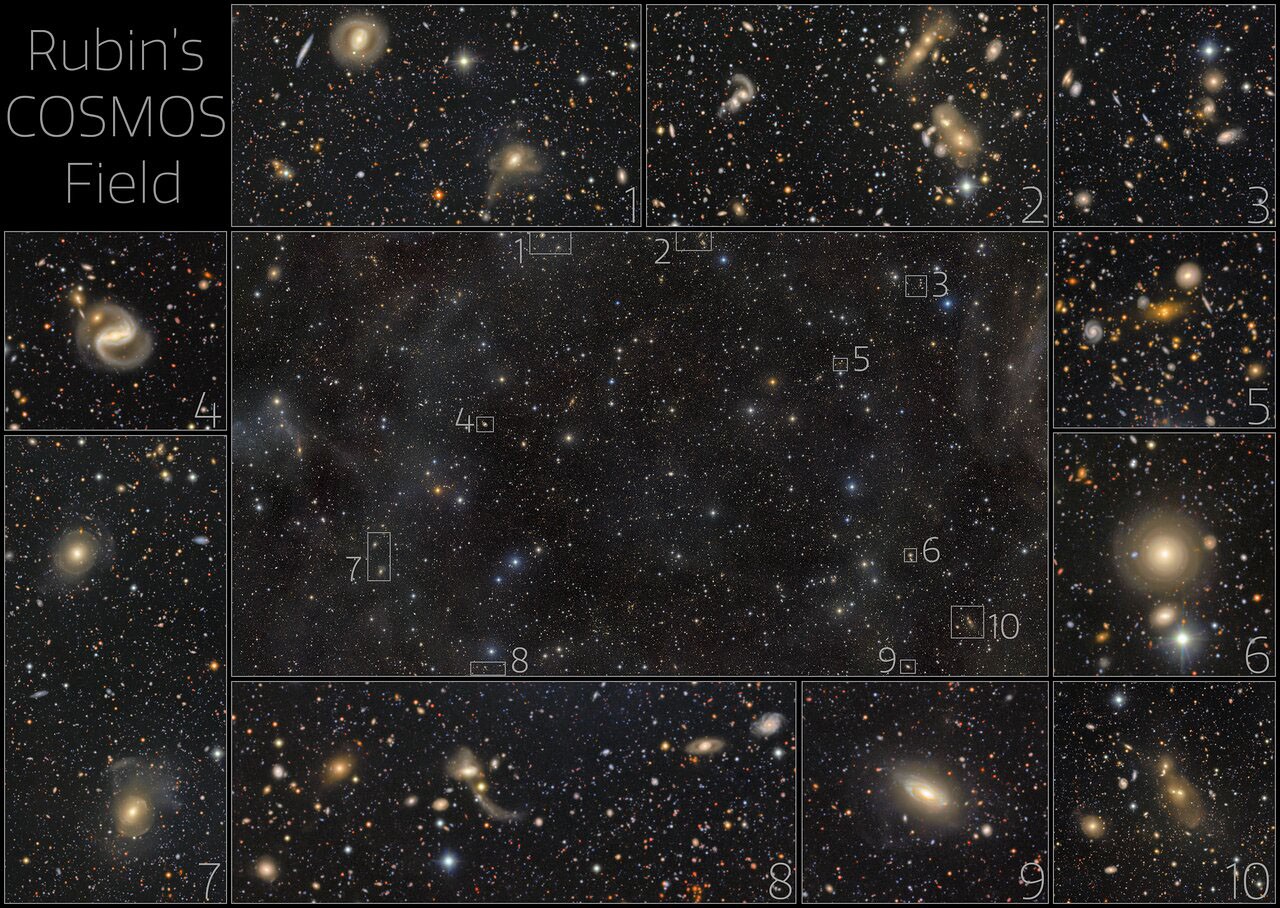
APOD: 2026 August 7 – Rubin’s Cosmos Field
The Vera C. Rubin Observatory captured an image of the COSMOS field containing over half a million galaxies. This is part of a ten-year Legacy Survey of Space and Time.
Why it matters
This region allows scientists an unimpeded view of distant galaxies because it contains few bright local stars. Frequent revisits will create a dynamic record of how the sky changes over time.
The details
- The COSMOS field is several times larger than the full moon.
- Light from some featured galaxies traveled for billions of years.
- Hubble and Webb telescopes have also observed this specific patch of sky.
Show entities and relationshipsHide entities and relationships
In this article
Organizations
Products
Countries
Key connections
U.S. Department of Energy is a partner of National Science Foundation
Jointly funding and managing the Vera C. Rubin Observatory
NOIRLab is related to Vera C. Rubin Observatory
Operating partner for the Vera C. Rubin Observatory
SLAC National Accelerator Laboratory is related to Vera C. Rubin Observatory
Key research facility supporting Vera C. Rubin Observatory instrumentation
Association of Universities for Research in Astronomy is related to Vera C. Rubin Observatory
Consortium managing astronomical operations for Rubin Observatory
National Science Foundation owns Legacy Survey of Space and Time
The Legacy Survey of Space and Time is a ten-year survey conducted by Vera C. Rubin Observatory under NSF.
Vera C. Rubin Observatory competes with Hubble Space Telescope
Vera C. Rubin Observatory observes the COSMOS field previously observed by Hubble.
Show 1 more connectionsShow fewer connections
Vera C. Rubin Observatory competes with James Webb Space Telescope
Vera C. Rubin Observatory observes the COSMOS field also observed by Webb.
Related events
Vera C. Rubin Observatory Captures Deep Image of COSMOS Field
Get the weekly recap
The stories like this one, picked and explained — once a week, straight to your inbox.