 Source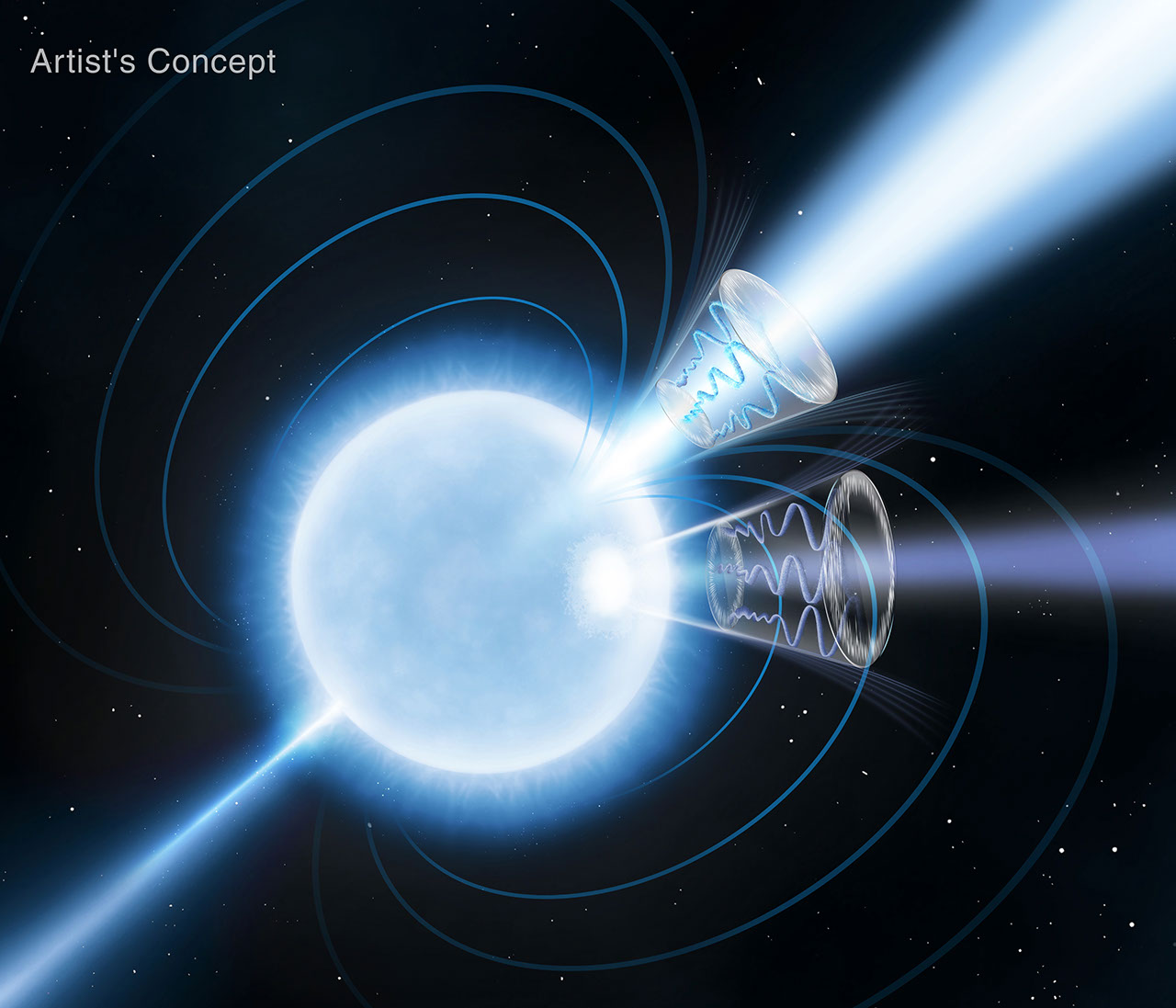
NASA’s IXPE May Have Proven 90-Year-Old Theory
NASA’s IXPE mission observed magnetar 1E 1547-5408 and found evidence supporting the theory of vacuum birefringence. This theory suggests extreme magnetic fields can alter empty space to act like a lens or prism.
Why it matters
These findings allow scientists to test fundamental physics in extreme environments that cannot be replicated in laboratories on Earth.
The details
- Observations occurred between March and April 2025 using IXPE, NICER, and Murriyang.
- Magnetar 1E 1547-5408 has magnetic fields over a trillion times stronger than Earth's.
- Vacuum birefringence was first proposed in 1936 as part of quantum electrodynamics.
Show entities and relationshipsHide entities and relationships
In this article
Organizations
Countries
Companies
Key connections
NASA NICER mission
CSIRO owns and operates the Parkes radio telescope
Italian Space Agency is a partner of NASA
Joint IXPE mission partner
BAE Systems, Inc. is related to IXPE
Manages IXPE spacecraft operations
Laboratory for Atmospheric and Space Physics is a member of University of Colorado
Institute at University of Colorado Boulder
Laboratory for Atmospheric and Space Physics is a partner of NASA
Manages IXPE spacecraft operations with BAE Systems
Show 9 more connectionsShow fewer connections
Hoa Dinh Thi works at Rice University
Postdoctoral associate at Rice University
Hoa Dinh Thi uses IXPE
Analyzed IXPE magnetar observation data
Rachael Stewart works at George Washington University
Ph.D. candidate at George Washington University
Rachael Stewart uses IXPE
Lead author on magnetar study using IXPE data
IXPE uses X-ray Polarimetry
Conducts X-ray polarization measurements of celestial objects
IXPE is related to Vacuum Birefringence
Measures X-ray polarization signatures supporting vacuum birefringence
IXPE is related to Quantum Electrodynamics
Tests predictions of quantum electrodynamics
Australia national science agency
NASA operates the Imaging X-ray Polarimetry Explorer (IXPE) space telescope.
Get the weekly recap
The stories like this one, picked and explained — once a week, straight to your inbox.